
By using this site, you agree to the Privacy Policy and Terms of Use.
Accept
clicktv.inclicktv.inclicktv.in
  • हिन्दी न्यूज़
  • CRITICLES
  • OPINION
  • CITIES
  • ELECTIONS
  • SPORTS
  • WORLD
  • INDIA
    • Arunachal Pradesh
    • Andhra Pradesh
    • Andaman and Nicobar
    • Assam
    • Bihar
    • Chhattisgarh
    • Goa
    • Uttar Pradesh
    • Uttarakhand
    • West Bengal
    • Gujarat
    • Haryana
    • Himachal Pradesh
    • Jammu and Kashmir
    • Jharkhand
    • Karnataka
    • Kerala
    • Lakshadweep
    • Madhya Pradesh
    • Maharashtra
    • Manipur
    • Odisha
    • Punjab
    • Rajasthan
    • Tamil Nadu
    • Tripura
  • Education
  • Crime
  • Business
Search
  • Terms of Use
  • Privacy Policy
Reading: Article 370: What is the impact of abrogation?
Share
Sign In
Aa
clicktv.inclicktv.in
Aa
  • Terms of Use
  • Privacy Policy
Search
  • हिन्दी न्यूज़
  • CRITICLES
  • OPINION
  • CITIES
  • ELECTIONS
  • SPORTS
  • WORLD
  • INDIA
    • Arunachal Pradesh
    • Andhra Pradesh
    • Andaman and Nicobar
    • Assam
    • Bihar
    • Chhattisgarh
    • Goa
    • Uttar Pradesh
    • Uttarakhand
    • West Bengal
    • Gujarat
    • Haryana
    • Himachal Pradesh
    • Jammu and Kashmir
    • Jharkhand
    • Karnataka
    • Kerala
    • Lakshadweep
    • Madhya Pradesh
    • Maharashtra
    • Manipur
    • Odisha
    • Punjab
    • Rajasthan
    • Tamil Nadu
    • Tripura
  • Education
  • Crime
  • Business
Have an existing account? Sign In
Follow US
© 2023 ClickTV.in. Designed By IBRAHIM ASHTAR . All Rights Reserved.
clicktv.in > Blog > CRITICLES > Article 370: What is the impact of abrogation?
CRITICLESINDIAJammu and KashmirOPINIONREPORTS

Article 370: What is the impact of abrogation?

Editor
Last updated: 2019/08/05 at 9:11 AM
Editor
Share
7 Min Read
SHARE

Click Tv

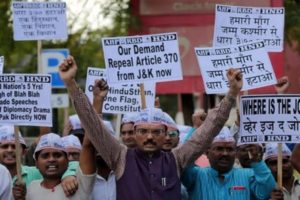
Union Minister for Home Affairs Amit Shah on Monday announced in the Rajya Sabha that Article 370 of the Indian Constitution is to be abrogated under the Constitution (Application to Jammu and Kashmir) Order, 2019 signed by President Ram Nath Kovind. This Gazette Notification (see below) states that, “[Constitution Order] shall come into force at once, and shall thereupon supersede [Article 370] as amended from time to time.”

What is Article 370?

This is a ‘temporary provision’ that serves the purpose of granting special autonomous status to Jammu and Kashmir, and makes special provisions for the state that are not applicable to other states.

Here’s a look at what the Constitution says:

Temporary provisions with respect to the State of Jammu and Kashmir

(1) Notwithstanding anything contained in this Constitution,—

(a) the provisions of Article 238 shall not apply now in relation to the state of Jammu and Kashmir;
(b) the power of Parliament to make laws for the said state shall be limited to—
(i) those matters in the Union List and the Concurrent List which, in consultation with the Government of the State, are declared by the President to correspond to matters specified in the Instrument of Accession governing the accession of the State to the Dominion of India as the matters with respect to which the Dominion Legislature may make laws for that State; and
(ii) such other matters in the said Lists as, with the concurrence of the Government of the State, the President may by order specify.

Explanation: For the purpose of this Article, the Government of the State means the person for the time being recognised by the President on the recommendation of the Legislative Assembly of the State as the Sadr-i-Riyasat (now Governor) of Jammu and Kashmir, acting on the advice of the Council of Ministers of the State for the time being in office.

(c) the provisions of Article 1 and of this Article shall apply in relation to that State;
(d) such of the other provisions of this Constitution shall apply in relation to that State subject to such exceptions and modifications as the President may by order specify:
Provided that no such order which relates to the matters specified in the Instrument of Accession of the State referred to in paragraph (i) of sub-clause (b) shall be issued except in consultation with the Government of the State:
Provided further that no such order which relates to matters other than those referred to in the last preceding proviso shall be issued except with the concurrence of that Government.
(2) If the concurrence of the Government of the State referred to in paragraph (ii) of sub-clause (b) of clause (1) or in the second provision to sub-clause (d) of that clause be given before the Constituent Assembly for the purpose of framing the Constitution of the State is convened, it shall be placed before such Assembly for such decision as it may take thereon.

(3) Notwithstanding anything in the foregoing provisions of this Article, the President may, by public notification, declare that this Article shall cease to be operative or shall be operative only with such exceptions and modifications and from such date as he may specify:

Provided that the recommendation of the Constituent Assembly of the State referred to in clause (2) shall be necessary before the President issues such a notification.

In October 1947, the then-Maharaja Hari Singh of Kashmir signed the ‘Instrument of Accession’, which specified three subjects on which Jammu and Kashmir would transfer its powers to the government of India: 1. Foreign affairs, 2. Defence and 3. Communications. In March 1948, the Maharaja appointed an interim government in the state, with Sheikh Abdullah as the prime minister. In July 1949, Sheikh Abdullah and three other colleagues joined the Indian Constituent Assembly and negotiated the special status of Jammu and Kashmir, leading to the adoption of Article 370.

Therefore, the Parliament needs the Jammu and Kashmir government’s nod for applying laws in the state — except defence, foreign affairs, finance, and communications.

The laws of citizenship, ownership of property, and fundamental rights of the residents of Jammu and Kashmir are different from the residents living in the rest of India. Under Article 370, citizens from other states cannot buy property in Jammu and Kashmir and the Centre has no power to declare a financial emergency.
What is important to note is that Article 370(1)(c) explicitly mentions that Article 1 of the Indian Constitution — which lists the states of the Union — applies to Kashmir through Article 370. This means that it is Article 370 that binds the state of Jammu and Kashmir to the Indian Union.

What is the impact of abrogation?

According to Live Law, “[S]uch abrogation would revert the relationship between Jammu and Kashmir and India to the terms of the accession instrument and confine New Delhi’s jurisdiction to only matters of external affairs, communications and defence and ancillary matters, with the rest of the matters falling within the jurisdiction of the current constitutional polity of Jammu and Kashmir.”

How this pans out in practice remains to be seen.

Source: https://www.firstpost.com/india/article-370-of-the-constitution-to-be-revoked-provisions-of-article-and-what-its-abrogation-means-for-jammu-and-kashmir-7111071.html

You Might Also Like

Century of Cinema Comes Alive at IFFD with T.R.I.S. Exhibition Showcasing Legends from Dilip Kumar to Shah Rukh Khan

The Actual Burial Site of Imam Hussain’s (RA) Head: A Historical and Scholarly Debate

Where’s the Holy Head of Hussain? Did You Really Stop To Think It Over in Your Head? Ghulam Rasool Dehlvi

“Our syncretic culture must be preserved for our national strength in the path of Sufis”: Syed Ashraf Kichauchchwi 

Ajmer Sharif: Closing ceremony of International Sufi Rang Festival 2022

TAGGED: #Article 370, #Jammu and Kashmir, Click tv, Clicktv, Clicktv.in

Sign Up For Daily Newsletter

Be keep up! Get the latest breaking news delivered straight to your inbox.
[mc4wp_form]
By signing up, you agree to our Terms of Use and acknowledge the data practices in our Privacy Policy. You may unsubscribe at any time.
Editor August 5, 2019 August 5, 2019
Share This Article
Facebook Twitter Copy Link Print
Share
Previous Article خدمت حجاج کی اہمیت و فضیلت
Next Article Restoring Kashmir as the sacrosanct place for Rishi-Sufism
Leave a comment Leave a comment

Leave a Reply Cancel reply

Your email address will not be published. Required fields are marked *

Stay Connected

235.3k Followers Like
69.1k Followers Follow
11.6k Followers Pin
56.4k Followers Follow
136k Subscribers Subscribe
4.4k Followers Follow

Latest News

Century of Cinema Comes Alive at IFFD with T.R.I.S. Exhibition Showcasing Legends from Dilip Kumar to Shah Rukh Khan
Events INDIA REPORTS THE-MEDIA-RUMBLE March 24, 2026
The Actual Burial Site of Imam Hussain’s (RA) Head: A Historical and Scholarly Debate
Jammu and Kashmir OPINION WORLD April 11, 2025
Where’s the Holy Head of Hussain? Did You Really Stop To Think It Over in Your Head? Ghulam Rasool Dehlvi
CRITICLES Jammu and Kashmir OPINION WORLD April 9, 2025
Bani Adam: Children of Adam and Human Rights Protection By Ghulam Rasool Dehlvi
Children's corner WORLD August 31, 2023
//

Quick Link

  • OPINION
  • INDIA
  • REPORTS
  • CRITICLES
  • WORLD
  • Term & Condition
  • Privacy Policy

Quick Link

  • Andhra Pradesh
  • Arunachal Pradesh
  • Assam
  • Bihar
  • Gujarat
  • Haryana
  • Jammu and Kashmir
  • Jharkhand

Sign Up for Our Newsletter

Subscribe to our newsletter to get our newest articles instantly!

[mc4wp_form id=”847″]

Follow US
© 2023 ClickTV.in. Designed By IBRAHIM ASHTAR . All Rights Reserved.
Join Us!

Subscribe to our newsletter and never miss our latest news, podcasts etc..

[mc4wp_form]
Zero spam, Unsubscribe at any time.
adbanner
AdBlock Detected
Our site is an advertising supported site. Please whitelist to support our site.
Okay, I'll Whitelist
Welcome Back!

Sign in to your account

Lost your password?