



Click Tv
Janet Armitage, Associate Professor of Sociology at St. Mary’s University in San Antonio, Texas, was a 2019 participant in the AIIS-CAORC Faculty Development Seminar to India. The seminar’s theme was urban sustainability and, in this essay, Armitage discusses her Indian experiences with women and water and the importance of bridging expert content with immersive experiences to expose faculty to current global issues. All photos are courtesy of the author.
Before I came to India as part of the CAORC-AIIS Faculty Development Seminar, I was under the assumption that air quality was India’s most pressing environmental concern. The notoriety of urban India’s smog from hazardous vehicle and industry emissions and crop burning is well documented, and it was immediately palpable once on the ground in Delhi. However, I quickly learned that water scarcity is an equal if not more pressing crisis.
Through the seminar, I, along with 15 other professors from community colleges and minority-serving institutions throughout the United States, was able to travel to northern and southern India to visit sites and hear from local experts to learn more about the country’s critical water issues. In Delhi, we met an architect who is working to clean the Yamuna River to revitalize it as a public sacred space for women and communities. In Jaipur, we heard from an engineer who is studying water consumption and especially the distinctive roles women have in consuming (and conserving) household water. All of the experts laid out the relationships between cities and water and underscored the importance of the local community—and women in their local communities—in water conservation, management, and activism.
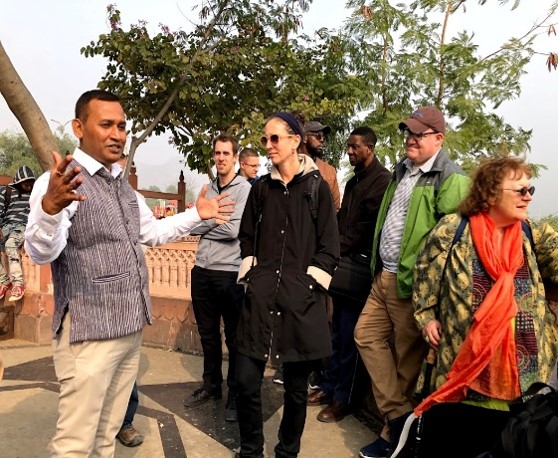
Throughout the two-week seminar, faculty participants heard from local experts on how India’s water crisis is being managed.
My understanding of urban India’s water crisis was further strengthened as I walked the streets of four Indian cities—Delhi, Jaipur, Mysore, and Bangalore—and saw the realities and diversity of water problems. In Delhi, I observed women digging through trash for recyclable water bottles and, in Mysore, children carrying water from public taps and water trucks. I stepped in and around the puddles left by leaky bore wells on the streets of Jaipur, and took in the expanse of concrete and corporations in Bangalore. Each distinctive water experience represented the complicated water issues of India.
In contrast to the expanse of problems, the seminar’s guided walking tours and specialist lectures revealed India’s commitment towards its sustainable development goals, particularly universal and equitable access to safe water and sanitation by 2030. I stood near the banks of Man Sagar Lake where the Jal Mahal Palace resides and learned about its habitable ecosystem that was only recently a sewage site. I also marveled at the rain harvesting efforts that are so prevalent across so many sectors of society. Organic architects discussed eco-smart designs for rooftop harvesting, while activists highlighted the work to conserve water in the country’s slums.
Dotting the slums we visited, for example, were countless buckets, paint cans, pots, and gallon-sized drums of all shapes and colors that were used for water collection. One of our seminar speakers, Harini Nagendra, author of Nature in the City, noted that the residents of slums harvest and conserve water differently than other urban residents. Water is prized and prioritized, and women consciously sacrifice water use to grow communal green spaces and personal gardens. Nagendra told us that women living in slums have forged “a symbolically significant relationship” between water and nature as a sign of their deep respect for nature and as a proactive strategy to improve lives and livelihoods. Nagendra’s insights connected women, water, and India as a key to solving the water crisis and securing urban sustainability.
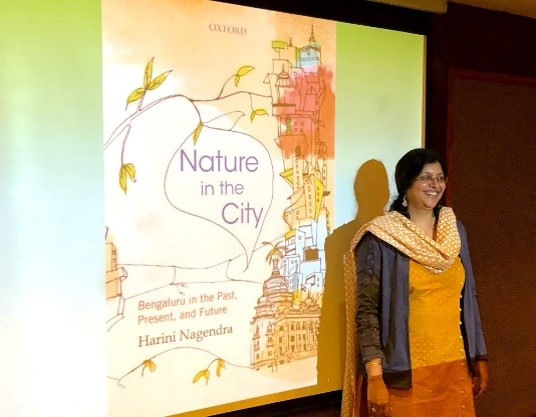
Speaker Harini Nagendra speaking to the faculty group about her book Nature in the City.
After only two weeks in India, I left with a heightened awareness about the country’s urgent water crisis and a new aspirational outlook inspired by those I met. From architects and engineers to activists and scholars, they were unified in working for the long-term well-being of India’s people, and they openly shared strategies for successful urban water conservation, management, and activism, notably connected to women in their local communities.
As a seminar participant, I was given an opportunity to observe their actions to combat urban issues and promote sustainability in 21st-century India. I saw an ambitious zero-waste treatment plant, wet and dry waste bins in “the Garden City,” and public campaign posters encouraging people to plant trees for happiness and to save every drop of water.
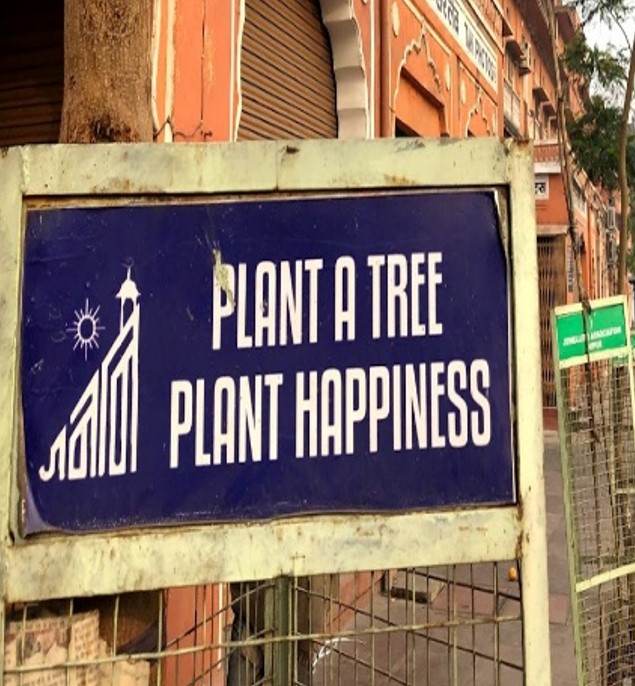
A recent campaign in India urging people to plant trees for happiness.
I could not help but consider the ways India could serve as a model for water conservation practices, particularly in light of the parallels between Indian states and my home state of Texas.
We are expected to double in population by 2060, with significant increases in cities and precipitous declines in the existing Texas water supplies. We, too, have a blend of climates, arid and wet, with slum-like border colonias where people lack access to clean water and sanitation. Texans must learn to use and share existing water supplies more efficiently and sustainably, and India may represent a promising model that could be adapted for our local use. By following India’s model in water harvesting, deep respect for nature, commitment to sustainable development goals, and local community efforts, Texas could achieve greater water security during this century.
I could not have made such meaningful connections without the integration of my immersive in-country experiences with the thoughtful lectures and expert perspectives of those who are so passionate about conservation and sustainability in urban India.
The AIIS 2019 faculty development seminar to India was organized with the Council of American Overseas Research Centers (CAORC) and supported by the U.S. Department of State’s Bureau of Educational and Cultural Affairs and the following U.S. National Resource Centers in South Asian Studies: Columbia University, Cornell University, Syracuse University, University of California, Berkeley, University of Pennsylvania, University of Texas, Austin, University of Washington, and University of Wisconsin, Madison.
Source: https://www.indiastudies.org/water-and-women-in-urban-india/?fbclid=IwAR2YCZPXAtvQEjeuO-Q6yrqkzufLZ_o8avBwiFvDS0UIOteYPxM8gUIcigU